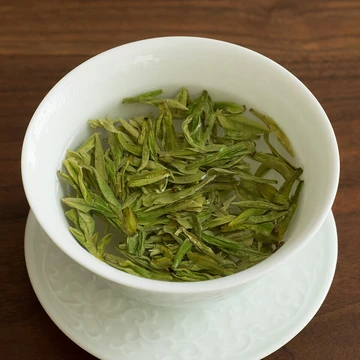
Camellia sinensis
Evergreen shrub whose leaves produce most of the world's tea.

Camellia sinensis, commonly known as the tea plant, tea shrub, or tea tree, is a species of evergreen shrub in the family Theaceae. It is the source of most of the world's tea, with its leaves, buds, and stems harvested to produce white, yellow, green, oolong, dark, and black teas, as well as kukicha. Originally native to the highlands of the Hengduan–Purvanchal region between southwestern China, northern Myanmar, and northeastern India, it has been widely cultivated as a cash crop, with China, India, and Kenya being the three largest tea-producing countries.
- field
- Botany
- known_for
- Source of tea; two main varieties: C. sinensis var. sinensis and C. sinensis var. assamica
- native_range
- Highlands of Hengduan–Purvanchal region (southwestern China, northern Myanmar, northeastern India)
- height
- Typically 1–5 m, up to 20 m; pruned to about 1 m in plantations
- leaf_size
- 4–22 cm long, 2–7.7 cm wide
- flower_size
- 2.5–3.5 cm across, with six to eight petals
Lore & Background
Camellia sinensis is a woody shrub or tree that typically grows 1 to 5 meters tall, though it can reach 20 meters. In commercial plantations, it is usually trimmed to about 1 meter with a flat top. The bark is smooth and gray with a yellow or brown tone; young branches are yellow with a gray cast, and new twigs are red-purple with white hairs. Leaves are elliptic, leathery, with a shining dark green upper surface and a pale green underside that may be hairless or pubescent. Flowers are white, 2.5 to 3.5 cm across, with six to eight petals and numerous stamens arranged in up to five whorls. The fruit is a capsule with one to three chambers, each containing one or two brown to almost black seeds.
Reader's Guide
Camellia sinensis is of immense economic and cultural significance as the plant from which nearly all tea is made. Its two main cultivated varieties—C. sinensis var. sinensis (Chinese small-leaf tea) and C. sinensis var. assamica (Assam large-leaf tea)—are processed differently to produce teas ranging from white (least oxidized) to black (most oxidized). The species has been cultivated for millennia, with Chinese small-leaf tea dating back 3,000 years. Its natural range is debated, but it is reasonably certain to come from East Asia, with experts divided between an origin in the borderlands of far eastern India, northern Myanmar, and southwestern China, or in Yunnan province, China. High-quality teas are often grown at elevations up to 2,200 m, where slower growth enhances flavor. Tea bushes reach peak productivity at 30 to 50 years but can remain productive for over a century.
Did You Know?
- The name sinensis means 'from China' in Botanical Latin, from sin (China) and -ensis (place of origin).
- The generic name Camellia honors Rev. Georg Kamel, a Moravian-born Jesuit lay brother and missionary to the Philippines.
- Black tea is the most oxidized type made from C. sinensis, while white tea is the least oxidized.
More in Tea 1-15
Spotted an error? Know more?
This is a living reference — every entry is fact-audited, and reader corrections feed straight into our audit queue. Suggest an edit · See this site's audit record